
The enabling layer for electric flight.
We don't build the aircraft. We build everything that lets a certified aircraft do useful work — and we integrate it so it actually flies as a system.
Power that doesn't wait for the grid.
A vertiport is not simply a landing pad — it has to support rapid turnaround, predictable passenger flow, and reliable charging cycles, which makes energy the real constraint. Industry analysis puts ground systems — vertiports, charging, and utility grid upgrades — at roughly $11.2 billion of the U.S. buildout. We design and deliver that layer: resilient power for airports, vertiports, and remote fields, engineered energy-first so operations keep moving even when the grid can't keep up.
- Solar and storagePV canopies plus battery storage (BESS), sized to real flight schedules.
- Green hydrogenon-site electrolysis and storage for fields that need fuel, not just charge.
- Microgrid controlgrid-tied or fully off-grid, with redundancy engineered in.
- Modular build-outvertiport pads and terminals that scale with demand, not ahead of it.

A 100-foot remote tower for the National Airspace System.
Not every airport can justify a staffed tower, but the airspace still needs eyes on it. Today's air traffic control was built for high-altitude flights between major airports; advanced air mobility adds distributed, low-altitude, high-frequency traffic — part of an estimated $5.4 billion in airspace and traffic-management modernization. Our fixed 100-foot remote tower is purpose-built for airport use, supporting National Airspace System field review in place of a manned tower, with the full traffic picture and flight support operators rely on.
- Fixed installationa permanent 100-foot remote tower, purpose-built for airport use.
- National Airspace reviewsupports NAS field review in place of a staffed tower.
- Airspace awarenessa full traffic picture with weather and surface sensing.
- Integrated powerruns on the resilient energy systems we already build.

Train the crews before the first flight.
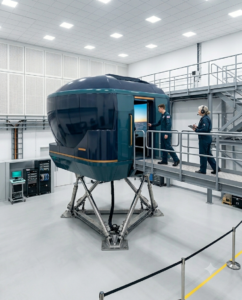
Every certified aircraft creates instant demand for simulators and the crews who can fly them. We build flight training devices and full-flight simulators, reverse-engineer existing platforms, and develop the software math models that make a simulator behave like the real thing — four decades of FAA- and EASA-qualified work, now aimed at eVTOL and hydrogen VTOL.
- FTD and FFS buildsfor new, second-tier, and emerging-OEM platforms.
- Reverse engineeringmath-model development for aircraft without turnkey data packages.
- Qualification supportaligned to FAA, EASA, and DoD training objectives.
- Legacy sustainmentupgrading and maintaining the models behind existing fleets.
Clean energy for the long way out.
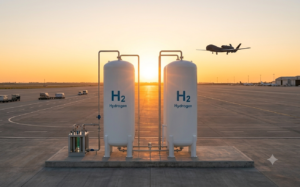
Hydrogen has powered industry safely for over a century. Light enough to disperse quickly if it leaks, dense enough in energy to fly farther than any battery — it's the fuel for the missions electrons can't reach. We work it on both ends: civil safety frameworks for vertiports, and liquid-hydrogen storage for long-endurance unmanned aircraft.
- On-site productiongreen-hydrogen electrolysis paired with solar and microgrid power.
- Safety-first designventilation, leak detection, and material compatibility built in.
- Liquid hydrogenstorage systems for the endurance gains batteries can't match.
- Operator trainingfirst-responder and crew frameworks aligned to national standards.
One partner for the whole stack.
Most programs stitch power, pads, airspace, and training together from a dozen vendors. We integrate them as one system — and manage it like the disciplined program it needs to be.